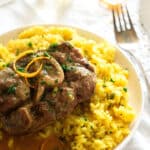
Veal Shank Recipe
These succulent and tender veal shanks in orange sauce are slow-cooked to perfection in a Dutch oven, allowing them to soak up the flavors of citrus and aromatic spices.
Servings: 4
Calories: 768kcal
Equipment
- Dutch oven
Ingredients
Veal shanks:
- 4 ½ lbs veal shanks cut into 2 inch/ 3 cm thick slices, 2 kg
- ½ teaspoon fine sea salt or kosher salt
- ¼ teaspoon ground black pepper
- 2 tablespoons all-purpose flour
- 2 tablespoons butter 30 g
Orange sauce:
- 3 oranges juice and peel, Note 2
- 1 piece leek the white part, 60 g/ 2 oz
- 1 small carrot 60 g/ 2 oz
- 1 ½ cups beef broth or chicken stock, Note 3
- 1 teaspoon thyme
- ½ cup orange juice freshly squeezed, 125 ml
- ½ cup white wine scant, 100 ml
- 1 tablespoon cornstarch
- 2 tablespoons cold water
- 2 teaspoons granulated sugar
- fine sea salt and ground black pepper
Instructions
Veal shanks:
- Flour veal shanks: Pat them dry with paper towels and sprinkle them with salt and pepper on both sides. Place the flour onto a large plate, dredge the shanks through the flour, and pat them gently to remove the excess. 4 ½ lbs/ 2 kg veal shanks + ½ teaspoon salt + ½ teaspoon pepper + 2 tablespoon flour
- Sear: Melt the butter in the Dutch oven. Brown the veal shanks in two batches for about 2 minutes per side. Remove them from the pot. 2 Tbsp/ 30 g butter
- Chop: In the meantime, chop the onion and the leek very finely, and cut the carrot into small cubes. 1 onion + 2 oz/ 60 g leeks (white part) + 2 oz/ 60 g carrots
- Sauté the vegetables with a pinch of salt in the Dutch oven for about 3 minutes or until softer, stirring frequently.
- Simmer: Pour in the broth, add thyme and a little salt and pepper, stir well, and return the meat to the pot. Bring to a boil, turn the heat down to low, and simmer, covered for 30 minutes. 1 ½ cup/ 375 ml beef broth or chicken stock + 1 teaspoon thyme + a little salt and pepper
Prepare oranges:
- Peel: Wash and dry them. Peel only the orange layer of the peel (the white parts are bitter). Cut the peel into fine strips. 3 oranges
- Blanch orange strips: In a small saucepan, bring water to a boil. Add the orange peel stripes and blanch them for 1 minute. Drain them well.
Orange sauce:
- Simmer: After 30 minutes of cooking, add the orange peel to the veal shanks in the pot. Stir to distribute them evenly in the pot, cover again, and continue simmering the shanks for another hour or until they are very tender.
- Carefully remove the meat from the pot using a slotted spoon. The shanks are very tender, and the meat might fall off the bone, move them gently.
- Strain the cooking liquid reserving the liquid and discarding the solids. Use a paper towel to wipe the Dutch oven clean.
- Cook orange sauce: Pour the strained cooking liquid back into the pot and add the orange juice, white wine, and 1 teaspoon sugar. Bring to a boil. ½ cup/ 125 ml orange juice + scant ½ cup/ 100 ml white wine + 1 teaspoon sugar
- Thicken sauce: In the meantime, whisk the cornstarch with cold water. Whisk the slurry into the simmering orange sauce to thicken it slightly. Let the sauce bubble for about one minute. 1 tablespoon cornstarch + 2 tablespoon cold water
- Adjust the taste with salt, pepper, and more sugar if needed. Return the shanks to the pot and spoon some of the sauce over them. Sprinkle with parsley if desired, and serve with risotto. salt + pepper + more sugar if required
Notes
- Veal shanks: 4-6 slices, depending on their size. Make sure that they are already sliced into thick slices, or ask the butcher to do it for you. You may not be able to cut them yourself at home.
- Oranges: It’s preferable to use organic, unwaxed oranges as you will also need their peel.
- Beef broth or chicken stock. Or veal stock if you can get any, but it’s usually not widely available. Low-sodium broth is preferable; it allows you to control the dish's overall saltiness better.
Nutrition
Serving: 1portion from 4 | Calories: 768kcal | Carbohydrates: 27g | Protein: 101g | Fat: 24g | Saturated Fat: 9g | Polyunsaturated Fat: 2g | Monounsaturated Fat: 8g | Trans Fat: 0.2g | Cholesterol: 398mg | Sodium: 1714mg | Potassium: 2005mg | Fiber: 3g | Sugar: 16g | Vitamin A: 2945IU | Vitamin C: 72mg | Calcium: 176mg | Iron: 5mg